
Hiragana ひらがな
This lesson is about the kana system known as hiragana. In this system, each sound corresponds to a mora. There are three types of characters: standalone vowels (V), consonant-vowel combinations (CV), as well as standalone consonants (C).
Sate, hajimemashō さて、はじめましょう! (Alright, let’s get started)!
Hiragana
ひらがな
When Japanese speakers learn hiragana, they use a chart called the gojūonzu 五十音図 (Table of 50 Sounds). Though not exactly 50 sounds, they are the most basic sound combinations, known collectively as seion 清音.

Learning how to properly read and write these characters will take time. This chart will be the only instance when hiragana are shown with their romanizations, along with their stroke orders, for brevity and conciseness. Please refer back to this chart as much as needed until you have mastered them. That being said, there are four characters which require special mention:
| ゐ | The hiragana for /wi/ is pronounced nowadays as [i]. It is only seldom used in personal and place names. |
| ゑ | The hiragana for /we/ is pronounced nowadays as [e]. It is only seldom used in personal and place names. |
| を | The hiragana for /wo/ is pronounced as [o] by most speakers. [wo], its traditional pronunciation, is preferred in music and conservative pronunciation. |
| ん | The moraic consonant /ɴ/ and all its allophones are represented with ん. One thing that must be noted is that in Standard Japanese, ん is never in word-initial position. |
General Handwriting Rules
書き順の基本ルール
1. Write strokes from top to bottom and left to right.
2. Make sure the end of the second stroke in あ is crossing the curve of the final stroke.
3. Make sure that the final stroke in け is slightly farther down than the first.
4. For せ, the second stroke usually does not have a hook.
5. For い, こ, た, ふ, り, and ゆ, do not connect the strokes together.
6. For む, if you connect stroke 2 and 3, do not add another slash.
7. Make sure the stroke 3 for お is not positioned far away from the rest of the character.
8. In more proper handwriting, the last stroke in さ and き is not connected with the rest.
Examples of Hiragana
「ひらがな」の使用例
The most effective way to learn hiragana is by practicing with real Japanese words written in hiragana. Below, you will find a list of 30 common words without romanization. Use the chart above to look up any symbols you are not familiar with as you practice reading these words.
| かたち shape | ゆめ dream | にほん Japan | ふつう usual | おわり end |
| ゆき snow | こねこ kitty | あかし proof | やくそく promise | いす chair |
| くさ grass | さら plate | しはらい payment | せき cough | みず water |
| かめ turtle | ちから strength | つうろ pathway | てんいん clerk | たに valley |
| ひみつ secret | ほし star | ふんいき atmosphere | のみもの drink | よる night |
| なまり accent | うみ sea | さかな fish | すみれ violet | からて karate |
The Diacritics ゛& ゜
濁点・半濁点
Diacritics are markings that are attached to glyphs to alter the pronunciation of said glyph. In the kana syllabaries, there are two diacritics: 「゛」1and 「゜」2.
- 「゛」: Attaches to an unvoiced consonant kana to change it to its voiced equivalent—e.g. か (/ka/) 右 が (/ga/).
- 「゜」: Attaches to /h/ kana to indicate /p/—e.g. は (/ha/) → ぱ (/pa/).
When writing these characters, follow the same stroke orders of the base kana, then add the diacritic.
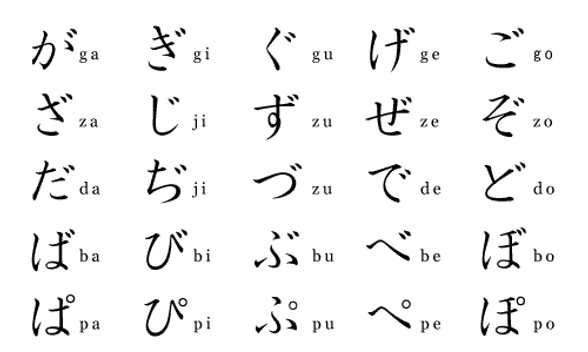
Also note that ぢ and づ are rendered as [ji] and [zu] respectively, though their base pronunciations are still /dji/ and /dzu/.
Examples of Words with Diacritics
濁点・半濁点を使った単語の使用例
| かず number | どく poison | かぐ furniture | かべ wall | ごぜん A.M. |
| がくせい student | かんぱい cheers | ふじさん Mt. Fuji | でかい huge | ごご P.M. |
| かぎ key | はなぢ nosebleed | かば hippo | ぜん Zen | かび mold |
| さんぽ walk | まつげ eyelash | うず whirlpool | ずつう headache | ふで brush |
| ぶんか culture | かがみ mirror | かぜ wind | ひじ elbow | ぜんぶ all |
| のど throat | かぞく family | ちず map | はだ skin | ぶぶん part |
Palatal Sounds in Hiragana
ひらがなにおける拗音
Palatal sounds are represented in hiragana by following a /i/–sound symbol with a small-sized /y/–sound symbol. These small-sized /y/–sound hiragana are ゃ, ゅ, and ょ, and they make the following combinations.

You will notice that there are two rows dedicated for writing [ja], [ju], and [jo]. Those made with ぢ as the primary kana are historically pronounced with the consonant [dj]. Today, kana of both rows are pronounced with either [dj] or [j] as valid allophones depending on the surrounding sounds (See Lesson 6). It is also worth noting that the ぢ row is particularly rarely used because these sounds only appear as the first mora of the second part of a compound.
Example Words w/ Palatal Sounds
拗音を使った単語の例
| きゃく customer | きょじん giant | にゅうよく bathing | きょく song |
| ちゅうごく China | じゅうしょ address | ひょうじ display | りゅうがく studying abroad |
| おちゃ tea | しゃかい society | ぎゃく opposite | ちょくせつ directly |
| じゃくてん weak point | ぎゅうどん gyudon | きゅう nine | しゅう week |
Mispronouncing Palatal Sounds
拗音の誤発音にご注意を
Palatalized consonants create minimal pairs3 with /y/–sound morae following morae ending in /i/. This means that mispronunciation will result in saying a different word. Consider the following words.
| i-sound + や・ゆ・よ | i-sound + ゃ・ゅ・ょ |
| じゆう freedom | じゅう ten/gun |
| りゆう reason | りゅう dragon |
| きゆう needless anxiety | きゅう nine |
| しゆう private ownership | しゅう week/state |
Long Consonants with Small “tsu”
長子音を示す促音「っ」
Long consonants are written with a small “tsu” before an unvoiced kana. This small “tsu” is formally known as the sokuon 促音. It is very important not to confuse it with a full-sized つ, as they are not pronounced the same.
| まっか bright red | よっか four days | こっか nation |
| みっか three days | さっか author | たっきゅう ping-pong |