
Katakana カタカナ
Katakana is often seen as the “neglected big brother” of hiragana. While both kana systems represent the same moraic sound combinations, they are used in different contexts. This lesson will begin by introducing the various katakana symbols and their sounds.
Katakana
カタカナ
We will first study the katakana symbols in the Gojūonzu 五十音図 (Table of 50 Sounds). The chart is the same as it is for hiragana. Pay attention to the stroke orders shown below so that your writing is legible.

Learning how to properly read and write these characters will take time. This chart will be the only instance when katakana are shown with their romanizations, along with their stroke orders, for brevity and conciseness. Please refer back to this chart as much as needed until you have mastered them. This being said, there are four characters which require special mention:
| ヰ | The katakana for /wi/ is pronounced nowadays as [i]. It is only seldom used in personal and place names. |
| ヱ | The katakana for /we/ is pronounced nowadays as [e]. It is only seldom used in personal and place names. |
| ヲ | The katakana for /wo/ is pronounced as [o] by most speakers. [wo], its traditional pronunciation, is preferred in music and conservative pronunciation. ヲ is rarely used in practice. |
| ン | The moraic consonant /ɴ/ and all its allophones are represented with ン. One thing that must be noted is that in Standard Japanese, ン is never in word-initial position. |
General Handwriting Rules
書き順の基本的なルール
1. Write strokes from top to bottom and left to right.
2. Horizontal strokes come before vertical strokes.
3. Take special note to the stroke orders of シ and ツ. The third stroke of シ is irregularly written from the bottom upward, whereas ツ is written regularly.
4. Also take note of the stroke orders of ソ and ン. The second stroke of ン is irregularly written from the bottom upward, whereas ソ is written regularly.
5. Whenever Rule 1 and Rule 2 conflict, Rule 2 takes precedence—e.g. キ.
Examples of Katakana
「カタカナ」の使用例
The most effective way to learn katakana is by practicing with real Japanese words written in katakana. Below, you will find a list of 60 common words without romanization. Use the chart above to look up any symbols you are not familiar with as you practice reading these words.
| アフリカ Africa | トマト tomato | アメリカ America | モスクワ Moscow |
| アクセス access | レタス lettuce | カクテル cocktail | ホテル hotel |
| エアコン air conditioner | カラオケ karaoke | ハンカチ handkerchief | タオル towel |
| オンライン online | アルミ aluminum | ミルク milk | センチ centimeter |
| オフライン offline | イタリア Italy | ナイフ knife | クラス class |
| カステラ sponge cake | フランス France | レモン lemon | システム system |
| ホチキス stapler | メキシコ Mexico | ロシア Russia | トヨタ Toyota |
| マラソン marathon | ノルマ quota | コロナ corona | レストラン restaurant |
| コメント comment | リンク link | リクエスト request | シナリオ scenario |
| サイレン siren | サンタ Santa | コアラ koala | トン ton |
| テニス tennis | イヤホン earbud | ストレス stress | マイナス minus |
| クリア clear | ケア care | コスト cost | コンテンツ content |
| センス sense | ノウハウ know-how | メンタル mental state | モラル morals |
| リアル real | レア rare | アイロン iron | アカウント account |
| アクセント accent | カラフル colorful | クリスマス Christmas | コンマ comma |
The Diacritics ゛ & ゜
濁点・半濁点
Diacritics are markings that are attached to glyphs to alter the pronunciation of said glyph. In the kana syllabaries, there are two diacritics: 「゛」1 and 「゜」2.
- 「゛」: Attaches to an unvoiced consonant kana to change it to its voiced equivalent—e.g. カ (/ka/) 右 ガ (/ga/).
- 「゜」: Attaches to /h/ kana to indicate /p/—e.g. ハ (/ha/) → パ (/pa/).
When writing these characters, use the same stroke order as the base kana, then add the diacritic.
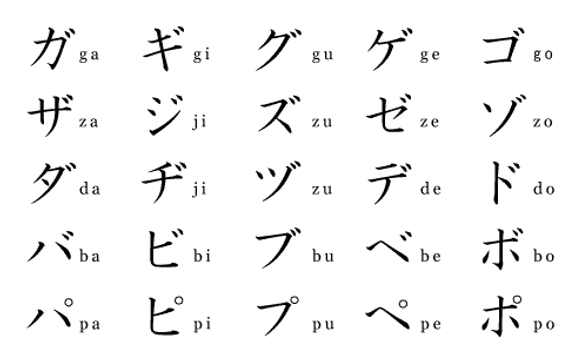
Also note that ヂ and ヅ are rendered as [ji] and [zu] respectively. While they are technically /dji/ and /dzu/ respectively, this reflects their usual pronunciation.
Examples of Words w/ Diacritics
濁点・半濁点を使った単語の使用例
| アドバイス advice | ラジオ radio | イギリス England | インド India |
| ポケモン Pokémon | イベント event | エプロン apron | オランダ Netherlands |
| エゴ ego | エジプト Egypt | カジノ casino | ガス gas |
| ギフト gift | クラゲ jellyfish | モンゴル Mongolia | ゴルフ golf |
| ピンク pink | サイズ size | サンダル sandal | ドル dollar |
| ゼロ zero | ゾンビ zombie | ダイヤモンド diamond | タイペイ Taipei |
| ベルリン Berlin | ロンドン London | フライパン frying pan | パンダ panda |
| テレビ TV | ズボン pants | マクドナルド McDonald’s | バスケ basketball |
| ビル building | ピザ pizza | メダル medal | ブラウザ browser |
| ゴミ trash | ピアノ piano | ビタミン vitamin | バス bus |
| パン bread | バナナ banana | デジカメ digital camera | パチンコ pachinko |
| ドア door | ビデオ video | パソコン personal computer | セレブ celebrity |
| カナダ Canada | プレゼント present | コンビニ convenience store | ダンス dance |
| ジム gym | シビア severe | タバコ tobacco | タピオカ tapioca |
| ダム dam | チヂミ Korean pancake | デバイス device | ドラマ drama |
Palatal Sounds in Katakana
カタカナにおける拗音
Palatal sounds are represented in katakana by following a /i/–sound symbol with a small-sized /y/–sound symbol. These small-sized /y/–sound katakana are ャ, ュ, and ョ, and they make the following combinations.
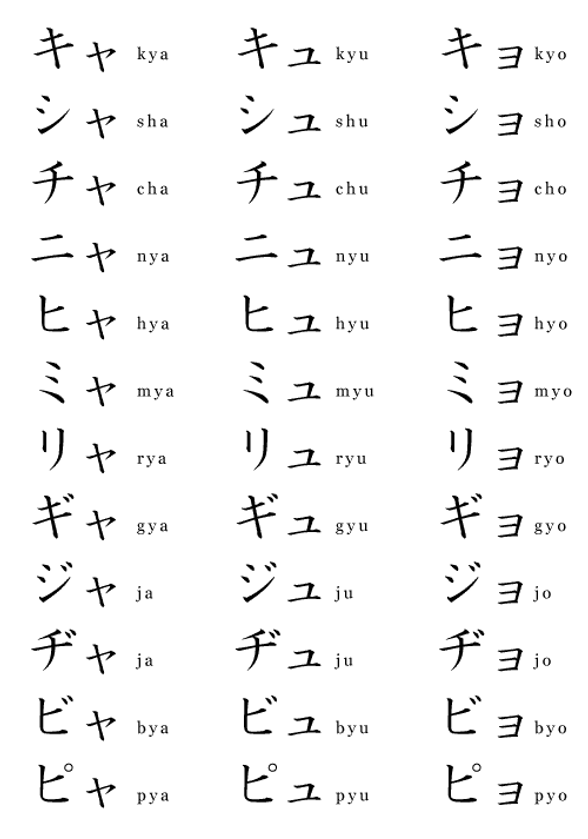
You will notice that there are two rows dedicated for writing [ja], [ju], and [jo]. Those made with ヂ as the primary kana are historically pronounced with the consonant [dj]. Today, kana of both rows are pronounced with either [dj] or [j] as valid allophones depending on the surrounding sounds— See Lesson 6. It is also worth noting that the ヂ row is rarely used. This is because they are only used as the first mora of the second part of a compound.
Example Words w/ Palatal Sounds
拗音を使った単語の例
| カジュアル casual | カリキュラム curriculum | キャベツ cabbage |
| キャンセル cancel | ギャンブル gamble | シャツ shirt |
| シャンデリア chandelier | ジャンプ jump | ジョギング jogging |
| チャイム chime | チャンネル channel | パジャマ pajamas |
| マンション condominium | ピュア pure | ジャズ jazz |
| ピョンヤン Pyeongyang | チャンピオン champion | ギクシャク awkwardness |
| ミュンヘン Munich | ジュニア junior | ジャンル genre |
| チュニジア Tunisia | シャンパン champagne | ギャング gang |
Extended Katakana
カタカナにおける特殊音
Katakana is most known for transcribing loanwords. These additional combinations3 help transliterate sounds which do not naturally occur in Japanese.
To write these sounds, new small kana4 —ァ, ィ, ェ, ォ, ヮ—were created.
| +/a/ | +/i/ | +/u/ | +/e/ | +/o/ | |
| /kw/+ | クァ・クヮ | クェ | クォ | ||
| /gw/+ | グァ・グヮ | グェ | グォ | ||
| /s/+ | スィ | ||||
| /z/+ | ズィ | ||||
| /sh/+ | シェ | ||||
| /j/+ | ジェ | ||||
| /t/+ | ティ | トゥ | |||
| /ch/+ | チェ | ||||
| /ts/+ | ツァ | ツィ | ツェ | ツォ | |
| /ty/+ | テュ | ||||
| /d/+ | ディ | ドゥ | |||
| /dy/+ | デュ | ||||
| /f/+ | ファ | フィ | フェ | フォ | |
| /w/+ | ウィ | ウェ | ウォ | ||
| /y/+ | イェ | ||||
| /v/+* | ヴァ | ヴィ・ヸ | ヴ | ヴェ・ヹ | ヴォ・ヺ |
Because these sounds do not naturally occur in Japanese, some become nativized to create a more “natural” pronunciation to native speakers. For example, /si/ and /zi/ are pronounced as [shi] and [ji] respectively by most speakers. Additional w-sounds and y-sounds are typically pronounced broken up as if they were written with full-sized characters—e.g. “kiwi” is pronounced as kiui キウイ or kiwi キウィ regardless of spelling. Lastly, /v/ is pronounced as [b] by most speakers. In older texts, /v/ was represented by adding ゛to a /w/–sound kana. Nowadays, “ヴ + small-sized vowel kana is the preferred method.
Words with Extended Katakana
カタカナで書かれた特殊音の入った単語
| ウォン Korean won | シェフ chef | チェス chess |
| ウェブサイト website | ネガティヴ negative | ディスク disc |
| ネイティブ※ native | プレッツェル pretzel | チェコ Czech |
| ディスコ disco | ファン fan | カフェ cafe |
| ファイル file | フェイク fake | フォンデュ fondue |
| フィリピン Philippines | イェルサレム Jerusalem | フォント font |
| ハイウェイ highway | フィルム film | フィギュア figure |
| マニフェスト manifesto | ウィキペディア Wikipedia | シェイクスピア Shakespeare |
| ファミレス family restaurant | クォリティ quality | ツェツェバエ Tsetse fly |
| ファイト fighting spirit | デュエット duet | おとっつぁん5 father |
Long Consonants w/ a Small “tsu”
長子音を示す促音「ッ」
Long consonants are represented by the small “tsu” (sokuon 促音), which in Katakana is ッ. It is very important not to confuse it with a full-sized ツ, as they are not pronounced the same.
| マット mat | アップ up(load)/(close-)up | ガッツ guts | クリック click |
| ロボット robot | エチケット etiquette | キャップ cap | コップ glass |
| アグレッシブ aggressive | カップル couple | ギャップ gap | カップ cup |
- The Japanese name for 「゛」 is dakuten 濁点, but it is colloquially referred to as てんてん or にごり. ↩︎
- The Japanese name for 「゜」is handakuten 半濁点, but it is colloquially referred to as まる. ↩︎
- These additional combinations are known in Japanese as tokushuon 特殊音. In the rare event hiragana is preferred, these extended glyphs can be mirrored into hiragana. ↩︎
- “Small kana” are collectively known as sutegana 捨て仮名. ↩︎
- おとっつぁん (dialectal word meaning “father”) shows how these additional sounds are written in Hiragana to represent non-Standard Japanese expressions. ↩︎