
Introduction to Japanese
日本語学習入門
Lesson 0 showcases what ought to be known about the language prior to beginning Japanese studies with いまび. Think of this lesson as a reference guide rather than a list of concepts to fully grasp or master immediately. It introduces ideas and topics that will be explored throughout the curriculum, so let’s use it to preview what lies ahead.
Japanese: A Japonic Language
日琉語族の言語・日本語
Japanese belongs to the “Japonic” language family, which comprises Japanese and several minority languages spoken within Japan. Native speakers of these languages find fellow Japonic languages much easier to learn than English. Interestingly, all speakers of these minority Japonic languages are also fluent in Japanese. The vocabulary of these languages are heavily influenced by Chinese languages, but they are not related to them.
Japanese’s placement in its own language family explains how any aspect of the language—phraseology, grammar structures, etc.—can be quite different from English. As a result, direct translations often produce awkward, unnatural, or even incorrect interpretations of the original Japanese. This highlights the importance of learning Japanese within its own context.
The Diversity of Dialects
方言の多様性
Japanese has dozens of dialects, which are variations of the language that developed over centuries of isolation, both internally and externally. The most widely understood form is Standard Japanese (hyōjungo 標準語1), which is largely based on the speech of Tokyo and serves as the language of instruction. Japanese speakers are quite familiar with their language’s rich dialectal diversity, as certain dialects are prominently featured in media, such as Kansai dialects in comedy.
To illustrate just how diverse these dialects can be, even simple phrases like “what are you doing?” vary significantly by dialect.
| Dialect | Japanese Script | Pronunciation |
| Tokyo Dialect 東京弁 | 何してるの? | Nani shiteru no? |
| Kansai Dialect 関西弁 | 何しとるん? | Nani shitoru n? |
| Nagoya Dialect 名古屋弁 | 何しとんの? | Nani shiton’ no? |
| Fukuoka Dialect 福岡弁 | 何しよっと? | Nan shiyotto? |
| Nagasaki Dialect 長崎弁 | 何ばしよっと? | Nam ba shiyotto? |
Whether you wish to play video games, read manga, or watch anime, you will inevitably encounter dialectal variation.
Japanese Pronunciation
日本語の発音
Words typically follow a simple “consonant + vowel” format, with few exceptions. The language features five vowels—/a/ (ah), /i/ (ee), /u/ (oo), /e/ (eh), /o/ (oh) – and fifteen core2 consonants—/m/, /p/, /b/, /n/, /t/, /d/, /s/, /z/, /r/ /y/, /k/, /g/, /w/, /ɴ3/, /h/. While these consonants are similar to their English counterparts, some subtle differences in pronunciation may be challenging to both perceive and master.
As a beginner, pronouncing words as they are spelled in English letters is generally acceptable. This approach will allow you to prioritize learning words and grammar while gradually training your ear to hear the nuances of Japanese pronunciation.
Japanese words are traditionally described as being composed of “morae,” a distinct concept from the notion of syllables. A mora is a unit of sound that is equivalent to one beat. Every “beat” is perceived as being equal in duration. In turn, Japanese distinguishes between short and long vowels as well as short (single) and long (double) consonants. Short consonants/vowels count as one mora, and long consonants/vowels count as two morae.
| Koko ここ here | Kōkō 高校 high school | Kōko 公庫 finance corporation |
| Kokō 孤高 solitary | Kokko 国庫 treasury | Kokkō 国交 diplomatic relations |
※Macrons indicate long vowels.
Here are some everyday phrases to read aloud. Do not worry about mispronouncing them or sounding perfect just yet. We will cover the pronunciation of vowels and consonants in detail over the next three lessons.
| Phrase 表現 | Japanese Script 表記 | Pronunciation 発音 |
| Good morning | お早うございます | O-hayō-gozaimasu |
| Good afternoon | こんにちは | Kon’nichi-wa |
| Good evening | 今晩は | Komban-wa |
| Good night | お休みなさい | O-yasumi-nasai |
| How are you? | お元気ですか | O-genki desu-ka? |
| Nice to meet you | 初めまして | Hajimemashite |
| Thank you | ありがとうございます | Arigatō-gozaimasu |
| Yes | はい | Hai |
| No | いいえ | Īe |
| I’m sorry; excuse me | すみません | Sumimasen |
Japanese also possesses a pitch accent system. In the Standard Japanese pitch accent system, each mora is assigned either a low or high pitch. Pitch allocation can largely be explained by four distinct patterns:
- Accent on the first mora: The pitch starts high on the first mora, then it drops on the next mora—leveling out.
- Accent in the middle: The pitch rises and reaches its highest point on the accented mora, then it drops immediately after.
- Accent on the last mora: The first mora is low, with the remaining morae pronounced at a high pitch. The pitch drops only when something is attached to the word, like a particle.
- No accented mora: Pitch rises and is maintained high throughout the word.
An accented mora is described as a rise in pitch that is immediately followed by a downstep in pitch. A downstep describes the drop in pitch after the final high-pitch mora in a phrase.
Pitch accent is often described as being beneficial in differentiating homophones (words that sound the same), but in reality, the allocation of pitch is arbitrary, and there are just as many examples of pitch distinguishing between homophones as there are examples of homophones possessing the same pitch pattern.
| Pattern | 1 Mora | 2 Morae | 3 Morae | 4 Morae |
| ①Accent on First Mora | H(L) [há↓] (tooth) | HL [á↓mè] (rain) | HLL [dé↓ǹkì ] (electricity) | HLLL [há↓mìǹgù] (humming) |
| ②Accent in Middle | ∅ | ∅ | LHL(L) [kùzú↓sù] (to demolish) | LHHL(L)/LHLL(L) [sàíká↓ì] (last place) |
| ③Accent on Last Mora | ∅ | LH(L) [shìká ↓] (deer) | LHH(L) [hàdómé ↓] (restraint) | LHHH(L) [imóótó↓] (little sister) |
| ④No Accent | L(H) [hà] (leaf) | LH(H) [àmé ] (candy) | LHH(H) [àbúrá] (oil) | LHHH(H) [sàíkáí] (reunion) |
※Accented morae as marked in bold, and downsteps are marked by ↓.
Japanese Grammar
日本語の文法
Japanese grammar differs significantly from English grammar. What may be normal in English grammar will almost surely result in incorrect Japanese.
Word Order 語順
The basic word order of Japanese is SOV (subject-object-verb).
- Subject: The “what” of the sentence, which is either “who4” is doing an action or “what” holds a certain attribute or effect; more than anything, it is what the predicate5 describes.
- Object: The entity that the action is directed toward.
- Verb: An action, occurrence, or mode of being.
Although SOV is the basic word order, the subject and object may flip if the object is deemed more significant. Additionally, a Japanese sentence can overtly lack a subject, object(s), or both its subject and object(s) if those elements are deemed obvious in context.6
| SOV | OSV |
| クマが漁師の魚を盗った。 Kuma-ga ryōshi-no sakana-wo totta. Gloss7: Bear-subject marker fisherman-possessive marker fish-object marker took. Translation: (A/The) bear took (a/the) fisherman’s fish. | 漁師の魚をクマが盗った。 Ryōshi-no sakana-wo kuma-ga totta. Gloss: Fisherman-possessive marker fish-object marker bear-subject marker took. Translation: (A/The) bear took (a/the) fisherman’s fish. |
| SV | OV |
| クマが盗った。 Kuma-ga totta. Gloss: Bear-subject marker took. Translation: (A/The) bear took (it/them). | 漁師の魚を盗った。 Ryōshi-no sakana-wo totta. Gloss: Fisherman-possessive marker fish-object marker took. Translation: (subject in context) took (a/the) fisherman’s fish. |
| V | |
| 盗った。 Totta. Gloss: Took. Translation: (subject in context) took (it/them). |
Other observations that can be made from these examples include:
・Japanese lacks articles (a, an, the).
・Japanese lacks grammatical number, which is the distinction between singular and plural forms.
・Japanese lacks grammatical gender, which in many languages is the distinction between masculine or feminine forms.
Order of Recognition
認知の順序
Japanese word order is not a free-for-all like it is often described. In fact, most sentences follow a predictable ordering of information, which is as follows:
TOPIC + TIME + LOCATION + SUBJECT + INDIRECT OBJECT +
DIRECT OBJECT + VERB/ADJECTIVE (PREDICATE)
- Topic: any detail that the speaker emphasizes as being central to the discussion.
- Time: expressions such as “today,” “tomorrow,” etc.
- Location: Phrases such as “at Tokyo,” “in China,” etc.
- Indirect object: The recipient of an action, such as in “to him.”
- Direct object: The entity that is primarily affected by the action of a verb, such as in “to throw a ball.”
The topic frames the conversation, followed by time to establish when things occur, then location to describe where events take place. The speaker may then introduce the subject or discuss what is being acted upon via direct and/or indirect objects, eventually leading to the verb or adjective (predicate).
How does this compare with English?
i. [鈴木先生は][毎日][生徒に][日本語を][教えています]。
[Suzuki-sensei-wa] [mainichi] [seito-ni] [Nihongo-wo] [oshiete-i-masu].
Gloss: [Suzuki-teacher-topic.marker] [every.day] [student(s)-indirect.object.marker] [Japanese-direct.object.marker] [teach-ing-politeness.marker].
Translation: Sensei Suzuki teaches Japanese to (his/her) student(s) every day.
Not only are familiar parts of a sentence arranged differently in Japanese compared to English, but some features, like the topic marker, have no direct equivalent in English.
Moreover, as we have seen, Japanese allows for sentences to be complete without including every possible element. While many sentences can have all the same elements present as they would in English (ii.), this is by no means a guarantee (iii.).
ii. [今朝][地震が][起きました]。
[Kesa] [jishin-ga] [okimashita].
Gloss: [This.morning] [earthquake-subject.marker] [occurred].
Translation: An earthquake occurred this morning.
iii. 今朝から揺れ始めた。(Subject Omitted)
[Kesa-kara] [yurehajimeta].
Gloss: [This.morning-since] [shake-started].
Translation: (The ground) started shaking as of this morning.
A Topic-Prominent Language
主題優勢言語
Japanese is said to be a “topic-prominent” language because it prioritizes details central to the conversation in its word order. Once the topic has been introduced, though, it need not be repeated, and it is often omitted after the first few instances. Interestingly, it is also possible for multiple topics to exist simultaneously for various grammatical purposes.
The topic does not have to be the same entity as the subject. However, when they are the same entity, the subject cannot be stated in tandem. This rule prevents redundancy. In place of the subject is an unspoken understanding – denoted by ø – that it is still grammatically present in the underlying sentence structure.
iv. [私は][今日]、[駅で][ø][友達に][本を][上げました]。
[Watashi-wa] [kyō], [eki-de] [(ø-ga)] [tomodachi-ni] [hon-wo] [agemashita].
Gloss: [I-topic.marker] [today] [train.station-at] [(unspoken subject)] [friend-indirect.object.marker] [book-object.marker] [gave].
Translation: I gave a book to a friend at the train station today.
When the topic and subject are not the same entity, the sentence follows a “as for X, Y…” pattern. This is not a one-size-fits-all translation, so how it is ultimately translated can vary significantly depending on the context.
v. [象は][鼻が][長い]。
[Zō-wa] [hana-ga] [nagai].
Gloss: [Elephant(s)-topic.marker] [nose-subject.marker] [long].
Translation: Elephants have long noses.
Left-Branching
主要部終端型(左枝分かれ構造)
Every phrase has a “head” and the possibility of there being a “modifier.” The “head” of a phrase is the element that determines the syntactic function of the phrase as a whole. In “the smart cat,” the head is “cat” because “cat” is the word that determines what the phrase means. A “modifier” provides additional information about the head. In “the smart cat,” “the” and “smart” are both modifiers of the head element “cat.”
In Japanese, modifier(s) always appear to the left of the head. This phenomenon is known as left-branching.
vi. 日本語の本
Nihongo-no hon
A/the Japanese book
In English, however, modifier(s) may appear to the left or to the right of the head. In the following two phrases, the modifier(s) are encased in (), while the head is encased in [].
vii. (The) (Japanese) [book]
viii. (The) [book] (in Japanese)
Japanese consistently exhibits left-branching no matter how long or complex modifiers may be. In English, both factors determine whether a sentence exhibits left-branching or, conversely, right-branching.
[Possessive Modifiers: Both Languages Exhibit Left-Branching]
ix. [私の[主人の[友達の[可愛い仔犬]]]
Watashi-no-shujin-no-tomodachi-no-kawaii-koinu
Gloss: [I-possessive.marker [husband-possessive.marker [friend-possessive.marker cute puppy]]]
Translation: My husband’s friend’s adorable puppy
[Participial Modifiers: Japanese → Left-Branching, English → Right-Branching]
x. [[学校から]帰った子供たちが][外で][遊んでいる]。
[[Gakkō-kara] kaetta kodomo-tachi-ga] [soto-de] [asonde-iru].
Gloss: [[School-from] returned kid-plural-subject marker] [outside-at] [play-ing].
Translation: (The) children who came back from school are playing outside.
Participle: [who came back from school] = 学校から帰った gakkō-kara kaetta
In Japanese, not only are participial modifiers placed to the left of their head, the elements which comprise said participial modifiers must also follow this left-branching principle. Meaning, if any adjectival phrase were to modify 学校 gakkō (school) in the Japanese sentence, it would appear to the left.
Note, that the small affixes sprinkled in the Japanese example sentences which denote grammatical functions (“particles,” see below) are not considered to be “modifiers” of the head but, rather, extensions of the head itself.
Macro-To-Micro
マクロ視点からミクロ視点へ
Japanese often organizes information from broad details to specific ones, which is called ‘macro-to-micro’ ordering. This is particularly common when giving details about time, place, or people.
①Telling Time
xi. 2024年8月第一週土曜日午前9時半20秒
Nisen’nijūyonen hachigatsu dai’isshū doyо̄bi gozen kuji-han nijubyо̄
9:30:20 AM on the first Saturday of August, 2024
②Creating Addresses
xii. 東京都大田区蒲田〇丁目
Tо̄kyо̄-to О̄ta-ku Kamata maru-chо̄me
District # of Katama in О̄ta Ward of Tokyo Prefecture
③Forming Names
xiii. 山田奈央
Yamada Nao
Nao Yamada
Agglutination 膠着性
Agglutination is the process of creating complex words by stringing morphemes (units of meaning) together into indivisible chains. The individual morphemes remain easily identifiable for their purpose.
Japanese is known to be a highly agglutinative language (kōchakugo 膠着語 ). In Japanese, agglutination is governed by a system of bases and endings. For every base that exists, several endings exist to attach to it. Each ending then has its own set of bases to potentially keep the chain going.
Consequently, “I did not want to be forced to eat” is expressed as one word made up of multiple morphemes. Endings within these chains exhibit fixed word order, meaning the morphemes cannot be shuffled around.
xiv. 食べさせられたくありませんでした
Tabe-sase-rare-taku-ari-mase-n-deshi-ta
Gloss: Eat-causative-passive-want-to.be-politeness.marker-negation-politeness-marker-past.tense
Translation: Did not want to be made to eat
The Japanese conjugation system utilizes six bases with which endings then attach based on mutual functionality. These six bases are as follows:
- Mizenkei 未然形 (Irrealis Form): Used to indicate actions that have yet to happen.
- Ren’yōkei 連用形 (Continuative Form): Used to indicate actions that are (being) carried out.
- Shūshikei 終止形 (Terminal/Predicative Form): Used to mark the end of a complete sentence.
- Rentaikei 連体形 (Attributive Form): Used to allow conjugatable parts of speech to directly modify nominal phrases.
- Kateikei 仮定形 (Hypothetical Form): Used to create hypothetical statements.
- Meireikei 命令形 (Imperative Form): Used to create commands.
Not using proper Japanese grammatical terms can hinder your learning experience. Without this terminology, it becomes difficult to discuss grammar concepts with native speakers or to conduct effective research in Japanese. Familiarizing yourself with these terms will greatly enhance your understanding and ability to engage with the language on a deeper level.
Name Ordering
人の呼び方
Native Japanese names follow macro-to-micro ordering. For foreign names, however, Japanese tends to honor the name ordering of the language of origin. Whatever your name is, that is what it is in Japanese, albeit with a Japanese-friendly pronunciation. As for Chinese or Korean names, their Kanji spellings are retained, and it is common to honor the original pronunciation over a Japanese-like pronunciation as humanly possible.
Also peculiar to English speakers is how titles come after a given name. While titles indicate social rank, the same title can be shared by countless people that fit said role. Therefore, names are treated as attributes to said titles, not the other way around. This results in phrases like, Obama-motodaitо̄ryо̄ オバマ元大統領 (literally, “Obama Former President”).
| 三島由紀夫 Mishima Yukio Yukio Mishima | 畑中先生 Hatanaka-sensei Teacher/Sensei Hatanaka | 習近平 Shū Kimpei Xi Jinping |
| 大阪なおみ Ōsaka Naomi Naomi Osaka | 伊藤社長 Itō-shachō Company President Itoh | ラファエル・グティエレス Rafaeru Gutieresu Rafael Gutierrez |
Inversion
倒置法
Japanese grammar typically places the predicate (verb/adjective/copula) at the end of a sentence. However, there are instances when the predicate comes first with the rest of the sentence stated as an after-statement. This phenomenon is known as inversion, which is often employed in music and poetry. Inversion can also naturally occur in everyday conversation for dramatic effect or when supplementing what the speaker would have otherwise intended to say first had the words occurred to them sooner.
xv. 叶え、私の願いよ。
Kanae, watashi-no negai-yo.
Gloss: Come.true I-genitive.marker wish-exclamation.marker
Translation: Come true, oh my wishes.
Omission
省略
Japanese allows for words whose roles can be deduced from context to be omitted from a sentence. The most famous instance of this is the tendency to drop pronouns such as “I” and “you” – a phenomenon known as “pro-dropping.”
xvi. お名前は何ですか。(No Overt Second-Person Pronoun Present)
O-namae-wa nan desu-ka?
Gloss: Honorific.prefix-name-as.for, what is-question.marker.
Translation: What is your name?
Omissions should never be interpreted as being absent in the underlying sentence structure. If omitted information cannot be retrieved and correctly interpreted by a speaker, said omission is consequentially ungrammatical. Thus, Japanese grammar requires its speakers to pay close attention to context to allow for such omissions to be possible. In return, omission allows for literary devices not found in English, adding unique layers of nuancing to Japanese discourse. As such, proper omission is crucial to sounding natural.
Speech Registers
文体の種類
One of the most challenging aspects of Japanese, even for native speakers, is mastering speech register. “Speech register” refers to the way one’s manner of speaking changes depending on the relationship with the listener(s). Japanese has five basic speech registers, each affecting how words and phrases are expressed. In some cases, these changes can be quite significant.
| Speech Register | Speaker-Listener Relationship | Forms of Ex. “To Say” |
| Honorific Speech (Sonkeigo 尊敬語) | Used to show utmost respect to the listener. | Osshaimasu Honorific Polite Form Iwaremasu Light Honorific Polite Form |
| Polite Speech (Teineigo 丁寧語) | Used to establish respect among equals who are not necessarily family or friends. | Iimasu Polite Form |
| Humble Speech (Kenjōgo 謙譲語) | Used to lower one’s status to show utmost respect to the listener. | Mōshiagemasu Super Humble Polite Form Mōshimasu Humble Polite Form |
| Plain Speech (Jōtaigo 常体語)) | Plain speech (basic) forms play grammatical purposes beyond register, but it also constitutes the register used among friends and family. | Yū Plain Form |
| Vulgar Speech (Bubetsugo 侮蔑語) | Used to degrade the listener. | Iiyagaru Nukasu Vulgar Forms |
All verbal expressions in Japanese vary according to speech register. Learners are typically first introduced to polite speech (teineigo 丁寧語), as it is used in public and formal interactions. However, the basic form of any phrase comes from plain speech (jōtaigo 常体語). To create polite forms, plain speech forms must be conjugated appropriately. Therefore, when learning conjugations, both plain and polite versions are taught side by side.
Terminology Note: “Plain speech” is normally referred to by kihonkei 基本形 (basic form) or futsūtai 普通体 (direct style).
Parts of Speech
品詞
There are twelve parts of speech in Japanese that fall under two categories: independent words (jiritsugo 自立語) or ancillary words (fuzokugo 付属語). Independent words are words that can stand alone, whereas ancillary words are words that cannot stand alone. Parts of speech can then be categorized based on their ability or lack thereof to conjugate.
| Part of Speech | Definition | Independent? | Conjugatable? |
| Verbs (Dōshi 動詞) | A word that describes an action, state, or occurrence. Ex. Oyogu 泳ぐ (to swim) | 〇 | 〇 |
| Adjectives (Keiyōshi 形容詞) | A word that describes an attribute. Ex. Furui 古い (old) | 〇 | 〇 |
| Adjectival Nouns (Keiyōdōshi 形容動詞) | A word that describes an attribute while also being noun-like. Ex. Kantan 簡単 (easy) | 〇 | 〇 |
| Nouns (Meishi 名詞) | A word that describes a person, place, state, quality, event, or thing. Ex. Inu 犬 (dog) | 〇 | X |
| Pronouns (Daimeishi 代名詞) | A word that indirectly describes a person, direction, or thing. Ex. Watashi 私 (I) | 〇 | X |
| Numbers (Sūshi 数詞) | A word that counts or measures entities. Ex. San | 〇 | X |
| Adnominal Adjectives (Rentaishi 連体詞) | A word that describes an attribute by directly modifying a noun. Ex. Kono この (this) | 〇 | X |
| Adverbs (Fukushi 副詞) | A word that qualifies an adjective, adjectival noun, or a verb. Ex. Mada まだ (still) | 〇 | X |
| Conjunctions (Setsuzokushi 接続詞) | A word that connects a sentence together. Ex. Shikashi 然し (however) | 〇 | X |
| Interjections (Kandōshi 感動詞) | A word that represents an abrupt/emotional remark/response. Ex. Hai はい (yes) | 〇 | X |
| Auxiliary Verbs (Jodōshi 助動詞) | An ending that attaches to a conjugatable part of speech. Ex. –nai ~ない (not) | X | 〇 |
| Particles (Joshi 助詞) | A word that marks some grammatical function. Ex. -(w)o を (object marker) | X | X |
Particles
助詞
One part of speech that is entirely foreign to English speakers is “particles.” Particles indicate grammatical functions, but many of these functions do not align neatly with English equivalents.
Japanese particles are typically classified into six types: case, parallel, conjunctive, final, adverbial, and bound particles. These classifications are based on their use within a sentence. Importantly, the same particle can serve different roles depending, leading to a change in its classification, but individual roles never overlap in context. Great attention to what sort of complements (elements) of the sentence they attach to must be made to insure particles are used correctly.
- Case: (Kaku joshi 格助詞): Indicates the grammatical function of a noun8.
- Parallel: (Heiritsu joshi 並立助詞): Juxtaposes two or more things together.
- Conjunctive (Setsuzoku joshi 接続助詞): Connects clauses together.
- Final (Shū-joshi 終助詞): Placed at the end of a phrase to provide emotional context.
- Adverbial (Fuku-joshi 副助詞): Indicates degree/condition/circumstance.
- Bound (Kakari joshi 係助詞): Emphasis markers which dictate that a certain conjugation be used.
Japanese Writing
日本語の表記体系
Japanese uses a mixed writing system that includes Chinese characters, called kanji (漢字), and two syllabaries, hiragana (ひらがな) and katakana (カタカナ). Kanji are used to represent meaning, while hiragana and katakana are used to represent sound. Additionally, even English letters have become incorporated into the writing system.
Kana: Hiragana and Katakana
仮名(平仮名・片仮名)
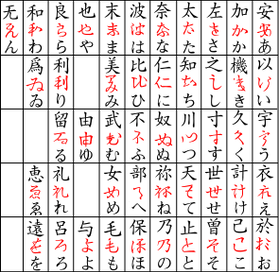
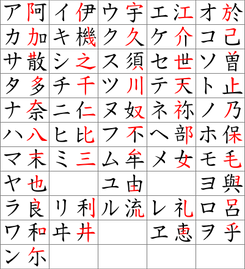
Hiragana ひらがな and katakana カタカナ are collectively referred to as kana9 syllabaries. Both syllabaries are used to write out sounds phonetically. The primary differences between the two lie in their historical development and practical applications. Both systems derive from simplifications of Chinese characters (kanji), which is illustrated by the charts below.
The first table illustrates the origin of hiragana. The top row shows the kanji which resulted in the modern hiragana symbol shown in the third row. The middle row shows how the cursive means of writing the kanji ended up becoming the hiragana symbol10. The table is read from right to left, up and down, with the vowels—/a/, /i/, /u/, /e/, /o/—listed in that order. Each subsequent column constitute the vowels combined with the consonant of said column—/k/, /s/, /t/, /n/, /h/, /m/ /y/, /r/, /w/, /ɴ11/—in that order.
The second table illustrates the origin of katakana. Each katakana symbol is paired with the kanji which produced it, with the katakana being on the left and the kanji on the right. The parts in red in each kanji indicate the specific parts that were extracted to form the katakana symbols. The vowels—/a/, /i/, /u/, e/, /o/—are listed in that order from left to right. The consonants for the subsequent rows are in the same order as above—/k/, /s/, /t/, /n/, /h/, /m/ /y/, /r/, /w/, /ɴ/—but this time listed from top to bottom.
Kanji
漢字
The exact number of kanji in existence is unknown. The Kanjigen 漢字源, one of the most authoritative kanji dictionaries for the Japanese language, lists 9,990 entries. The most comprehensive proficiency test, the Kanji Nōryoku Kentei Ikkyū 漢字能力検定一級, covers roughly 6,000 kanji. As for the average Japanese reader, most are familiar with over 3,000+ characters, and this number is gradually increasing thanks to the convenience of typing on electronic devices.
The Jōyō Kanji 常用漢字 are kanji designated by the Japanese Ministry of Education as the basis for literacy, of which there are 2,136 as of 2017. Additional characters are designated as Jimmeiyō Kanji 人名用漢字 for name-use, of which there are 862 as of 2017.
Beyond the sheer number of kanji, most characters have multiple readings (pronunciations), adding another layer of complexity to learning them. Readings which derive from earlier stages of various Chinese languages are known as ON readings (音読み on’yomi), and readings which generally correspond to native Japanese vocabulary are known as KUN readings (訓読み kun’yomi).
| Kanji | ON Reading | KUN Reading |
| 葉 (leaf) | YŌ | ha |
※For ease of identification, ON readings tend to be capitalized in romanization and written in katakana in Japanese proper. Conversely, KUN readings tend to be lower-case in romanization and written in hiragana in Japanese proper.
While the number of ON readings is limited to how many times throughout antiquity newer readings were borrowed from the Chinese mainland, the number of KUN readings is determined by how many native words were attributed to the same kanji, each being distinguished from one another via context as well as differences in okurigana 送り仮名 (kana used to indicate native inflection).
| Kanji | ON Reading(s) | KUN Reading(s) |
| 強 (strong) | KYŌ → 強化 KYŌKA (strengthening) GŌ → 強盗 GŌTŌ (robbery) | tsuyo(i) 強い (to be strong) tsuyo(maru) 強まる (to be strengthened) tsuyo(meru) 強める (to strengthen) shi(iru) 強いる (to coerce Kowa(i) 強い (to be tough) anaga(chi) 強ち (not necessarily) |
| 山 (mountain) | SAN → FUJISAN 富士山 (Mt. Fuji) ZAN → KAZAN 火山(volcano) SEN → SHUMISEN 須弥山 (Mount Meru) | yama 山 (mountain) |
| 火 (fire) | KA → 点火 TENKA (ignition) | hi 火 (fire) –bi → 弱火 yowabi (low flame) ho– → 火照る hoteru (to feel hot) |
In addition to varying okurigana 送り仮名, best exemplified by the various KUN readings of 強 above, various derivations of native Japanese words themselves result in different KUN readings, which is made evident above with 火. Differentiating between these KUN readings requires understanding how Japanese morphology works, which, while intuitive to native speakers, can be very challenging to learners.
Character Simplification
漢字の簡略化
After World War II, many kanji were simplified. The older, more complex forms of these characters are known as Kyūjitai 旧字体, while the simplified versions that were introduced are called Shinjitai 新字体. You may still encounter the older forms Kyūjitai 旧字体 in names and publications prior to the 1960s. Most speakers are generally familiar with these traditional forms.
| Meaning | Traditional | Simplified | Meaning | Traditional | Simplified |
| yen | 圓 | 円 | learning | 學 | 学 |
| battle | 戰 | 戦 | turtle | 龜 | 亀 |
Curriculum Note: To learn more, see Kanji Simplification.
Japanese-Made Kanji
国字
Japanese speakers have also created their own kanji over the centuries. These kanji are known as kokuji 国字 or wasei kanji 和製漢字.
| Meaning | Character | Meaning | Character | Meaning | Character |
| field | 畑 | to work | 働 | smell | 匂 |
| enclosure | 塀 | mountain pass | 峠 | frame(work) | 枠 |
Curriculum Note: To learn more, see Japanese-Made Kanji.
English Letters
ラテン文字の使い方
The use of English letters in the formation of new words is becoming ever more common. You will even see Arabic numerals (1, 2, 3, 4, etc.). The pronunciations of these letters and numbers have been adapted to fit Japanese.
| Example | Meaning |
| PR (Piiāru) | public relations |
| OL (Ōeru) | female office worker |
| CD(Shiidii) | CD |
| Tシャツ (Tiishatsu) | T-shirt |
| PM2.5 (Piiemu nii ten go) | fine particles (PM 2.5) |
| LGBT(Erujiibiitii) | LGBT |
The use of full-width characters is preferred in Japanese. In English, half-width characters are exclusively used.
Rōmaji ローマ字 refers to writing Japanese in English letters, a process known as romanization. Here at いまび, a modified version of what is known as the Hepburn romanization system (ヘボン式) is implemented when appropriate.
Punctuation
句読法
Japanese was once void of any punctuation. However, due to contact with Western languages, Japanese has borrowed and adapted many punctuation marks.
| Punctuation Mark | Japanese Punctuation |
| Period | 。 |
| Comma | 、 |
| Exclamation Point | ! |
| Question Mark | ? |
| Quotation Marks | 「」 |
| Double Quotation Marks | 『』 |
Perhaps even more bizarre is that Japanese generally lacks spaces between words. Boundaries between phrases are meant to be obvious in context thanks to its mixed script.
Word Etymology
単語の由来
Japanese vocabulary comes from three sources: native words, Sino-Japanese words, and loanwords from other modern languages.
・Native words form the core of the language, making up over 60% of the words used in everyday conversation.
・Sino-Japanese words are words either directly borrowed from older forms of Chinese or words created from those roots. While they constitute over 60% of the language’s overall vocabulary, they account for only about 20% of words commonly used in conversation.
・Loanwords primarily come from English, though there are plenty of examples of borrowings from other languages.
| Native | Sino-Japanese | LoanWORD |
| yama 山 mountain | kazan 火山 volcano | doa ドア (borrowed from English door) door |
| mizu 水 water | genki 元気 lively/well | zubon ズボン (borrowed from French jupon) pants |
Spoken vs Written
「口語」と「文語」との違い
To communicate effectively in Japanese like a native speaker, it is equally important to learn how to read, write12, and speak. The spoken language is full of colloquialisms, filler words, and nuanced undertones difficult to express in the written language. On the other hand, the written language is characterized as being formal, void of colloquialisms, and having a higher concentration of complex vocabulary and kanji.
| Meaning | Spoken Language | Written Language |
| (And) then | そんで | それで |
| (Not) at all | ちっとも | 少しも |
| Various | 色んな | 色々な |
| Finally | やっと | 漸く |
| Spoken Language | 話し言葉 | 口語 |
| Written Language | 書き言葉 | 文語 |
Alternative kanji spellings also help enrich the written language in ways not possible in the spoken language. Take, for example, the word toru meaning “to take.” Though it is just one word, it has all these different kanji spellings which differ only by what nuance of the word is intended.
| Kanji Spelling | Nuance |
| 取る | “to take” in the broadest sense possible. |
| 撮る | to take a photo |
| 摂る | to take vitamins, etc. |
| 採る | to take a sample; to take a measure; to take flowers = to pick flowers |
| 執る | to take command |
| 捕る | to take an animal captive = to catch |
| 獲る | to take as prey/as one’s prize |
| 盗る | to take = to rob |
| 録る | to take a recording |
In Conclusion 最後に…
Having learned so much about Japanese, now it is time to learn Japanese. Through the in-depth curriculum that いまび provides, you will learn all that you need to know to truly master the language.
Lastly, gambatte kudasai 頑張ってください (good luck)!
- Hyōjungo 標準語, interchangeably referred to as kyōtsūgo 共通語, translates as “lingua franca.” Since Standard Japanese is the “lingua franca” of Japan, the two terms overlap in practicality. ↩︎
- Many consonant sounds have alternate pronunciations (allophones) which appear in unique environments, which are not reflected in this count. ↩︎
- /ɴ/ is a consonant not found in English. Though written with a stylized “n,” its basic pronunciation is made with the uvula. It is also known for having many allophones. ↩︎
- When a subject is the doer of an action, that subject is more precisely described as being the “agent.” ↩︎
- The predicate is the part of a sentence or clause containing a verbal element which states something about the subject. Predicates are composed of verbs, adjectives, or the copula verb. These predicate types all share parallel conjugation morphology. ↩︎
- When a subject or object is dropped, it still remains structurally tied to the sentence despite its absence. This is why if they cannot be understood in context, the sentence becomes ungrammatical. ↩︎
- A linguistic gloss gives a literal breakdown of each part of a sentence. Word boundaries and what constitutes a meaningful unit of meaning differ between languages. This is why glosses are so important to grammarians. ↩︎
- Many case particles have multiple, often interrelated functions, and which function is intended will always be determined by the predicate (element of the sentence that composes the core event/action). ↩︎
- When hiragana was invented, it was often called “woman’s writing” (on’nade 女手), whereas “man’s writing” (otokode 男手) was consumed by the use of kanji. However, that is not to say that men did not use both kana scripts. The word “kana” derives from kari 仮 meaning “temporary” and na 名 meaning “letters (of a writing system).” In turn, kanji were referred to as “true characters” mana 真名. Hiragana derived directly from the cursive forms of kanji. Katakana derived from abbreviations of kanji used as reading aids for Chinese texts to be interpreted into Japanese. The prefix kata– 片 goes back to each glyph is a “partial” representation of a full kanji. ↩︎
- Hiragana variants that exist today differ in how broken down (degree of cursivity) the original kanji is written. ↩︎
- /ɴ/ is a moraic, uvular nasal consonant and is responsible for why Japanese is described as having “morae” instead of “syllables.” Consequently, the kana syllabaries are not true syllabaries given how this phoneme has its own symbol. More will be learned about this unique phoneme in Lesson 2. ↩︎
- “Writing” does not solely refer to writing things by hand. As is the case in any language, most “writing” in Japanese is done in the form of typing and texting. ↩︎